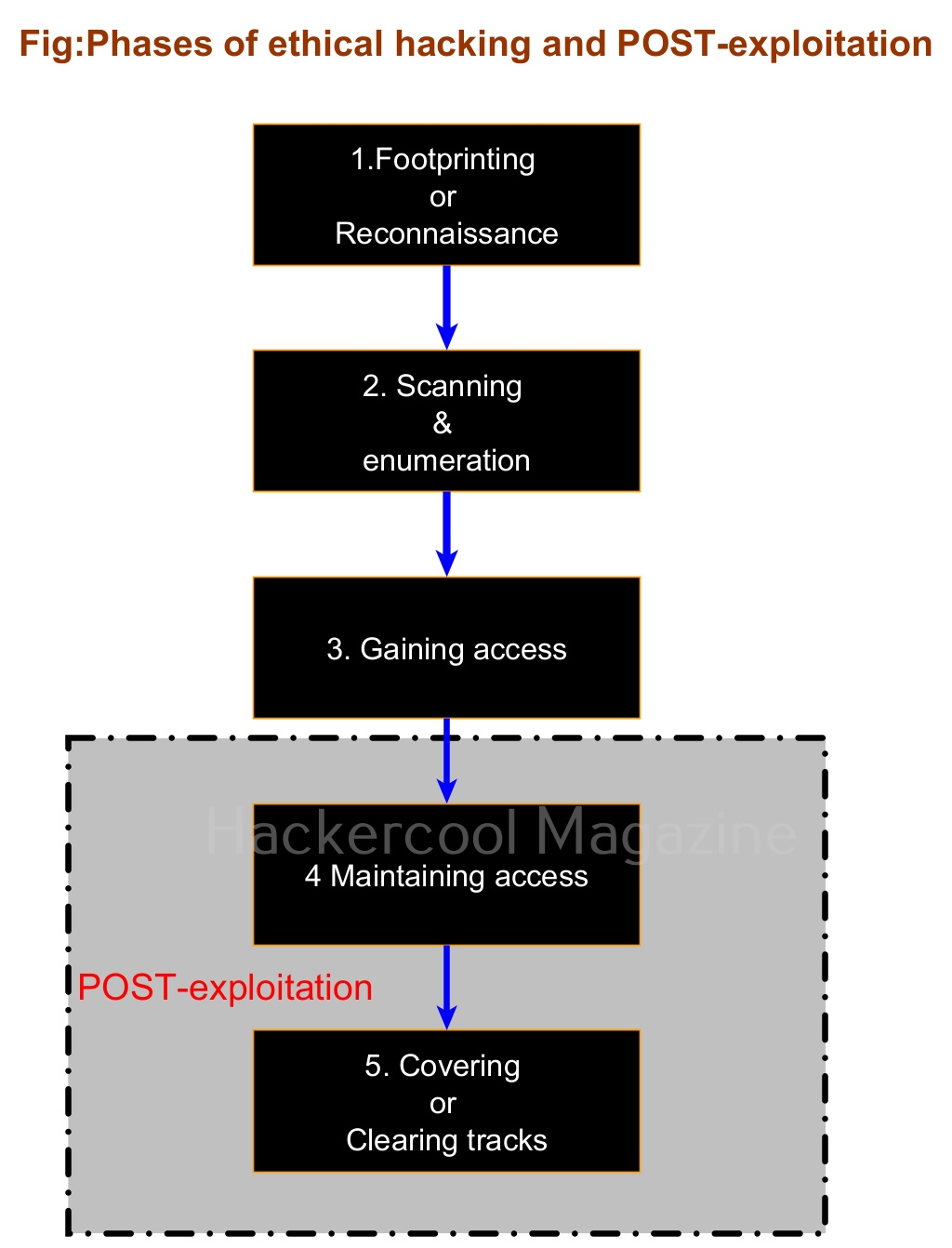
Hello, aspiring ethical hackers. In this blogpost, you will learn about POST-exploitation. POST-exploitation comes after the phase of gaining access in ethical hacking.
NEW TO ETHICAL HACKING?
Start your ethical hacking journey with our FREE Beginner Ethical Hacker Starter Kit (2026 Edition).
Get beginner-friendly guidance to understand the fundamentals of ethical hacking and take your first steps into cybersecurity.
What is POST-exploitation?
POST- exploitation refers to all the operations that are performed after gaining initial access on the target system. It is done to further gain control of the target system and network. POST -Exploitation consists of three phases mainly. They are,
Let’s learn about each in detail.
READY TO BUILD YOUR ETHICAL HACKING FOUNDATIONS?
Go beyond the basics. Develop the essential knowledge every aspiring ethical hacker needs.
Your learning package includes:
Networking Fundamentals
Linux Fundamentals
Windows Fundamentals
Web Fundamentals
Command Line Essentials
Virtual Labs
$1 INTRODUCTORY TRIAL
6 Foundation Resources + Full Magazine Access
Trial terms apply. Post-trial subscription billing is manual.
1. Privilege escalation:
Privilege escalation is an act of gaining elevated access to resources that are normally restricted to an application or user. Privilege escalation is an act or process of gaining access to privileges of the other user account using any means or techniques. Normally privileges of user account with higher privileges are targeted by hackers. Learn more about privilege escalation.
2. Maintaining access:
Maintaining access is the fourth phase in the total 5 phases of ethical hacking. In this phase, hackers try to hold on to the initial access or foothold they have gained on the network. For this, they use various techniques like elevating privileges, installing backdoors, running persistence scripts and tunneling.
3. Covering Tracks:
Covering tracks or clearing tracks is the phase of ethical hacking in which a hacker tries to erase all the evidence on the target system that can lead back to the hacker. For covering tracks, hackers perform various actions like clearing logs, time stamping files etc.
YOUR ETHICAL HACKING JOURNEY STARTS HERE!
Not sure where to begin? Download our FREE 18-page Beginner Ethical Hacker Starter Kit (2026 Edition).
Take your first step towards building practical cybersecurity knowledge.